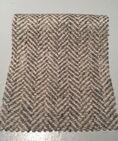
| In he exhibition 100% wool in the Museum of Design and Applied Art 2020 a little wonder had happened where twill, tweed and herringbone fabrics were being shown, all made from Icelandic wool. I had always thought that the Icelandic wool wasn´t suitable for weaving ,,normal" fabric but it seemed that it just needed more spinning before being worked into fabric. The Icelandic wool is made of two layers where the upper layer called tog that can be spun ,,endlessly" or has the most art in it while the lower layer thel has be likened with finer kinds of wool. Separating these two layers has always been time consuming hand-craft where the appropriate machines to separate the layers are not existent here and making the wool water repellent and maybe more suited for outdoor garments . The spinning part deduces those rather dominant abilities and dthe end fabric has a rather nice shine to it. Spinning seems to be the key element for making a fabric. |
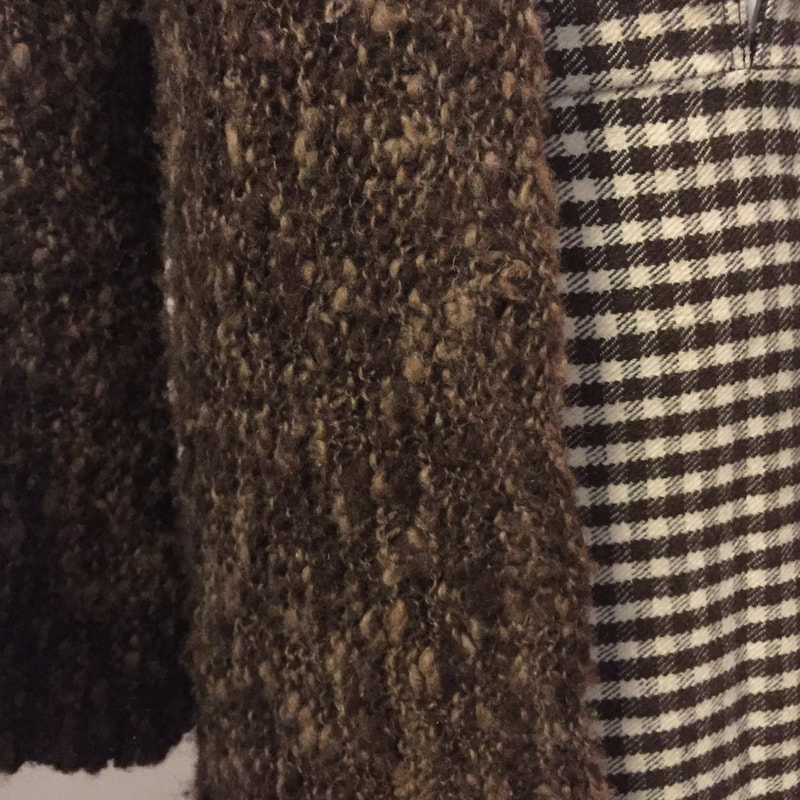
| Spinning has a lot of history and the painting by Rossetti on the pattern - page shows a girl spinning with a spindle just as is the case with the garment on the picture to the left. The cardigan gets a nice fashionable, bouclé effect when the yarn in it is not spun too much with, of course, the knitting effect while the skirt´s fabric worked in 1947, also hand spun, looks like a very normal plaided wool skirt. And everything in Icelandic wool! When homepage of various textile associations worldwide are visited a nice, friendly façade comes up, with displays of various designs in textile that come out marvellously when the design´s main ingredient the textile is regarded. There is still a lot to be said in that area especially with regard to seflsufficiency. I have tried kambgarn (combyarn), cashmere and angora and all these yarns work excellently with the knitting machine. I know the secret lies in developing yarn for the loom and knitting machines.. |